Easy to play
Run, jump, dive, grab. You understand the controls inside five seconds and you're in the match on your first try.
Thirty-two Bonkers, one gate, and a wall of doors behind it where only some of them open. About four seconds before it stops being orderly.
Every Bonker knows exactly where the finish line is. That was never the hard part. BONK PARTY is built on three rules, and the third one is why no two matches ever land the same way.
Run, jump, dive, grab. You understand the controls inside five seconds and you're in the match on your first try.
Winning takes timing, map knowledge, positioning and risk management. Shortcuts exist. Most players never find them.
Players collide, block, launch and fall into each other constantly. The physics stay unpredictable without ever taking the controls out of your hands.
The BONK is a short physical bump against a nearby opponent. It's the difference between a race and a party. It also has a cooldown — throw it early and you're the one who ends up in the pit.
21:04:12 — Zip is two strides from qualifying.
21:04:13 — Momo BONKs Zip away from the finish.
21:04:13 — Both players fall.
21:04:15 — Bobo qualifies. Bobo was facing the wrong way.
"I can't believe that happened."
The line every match is designed to produce.
Each match shuffles its rounds, so the ladder you climbed last game won't be the one you climb next. Hover a card to see what's in rotation.
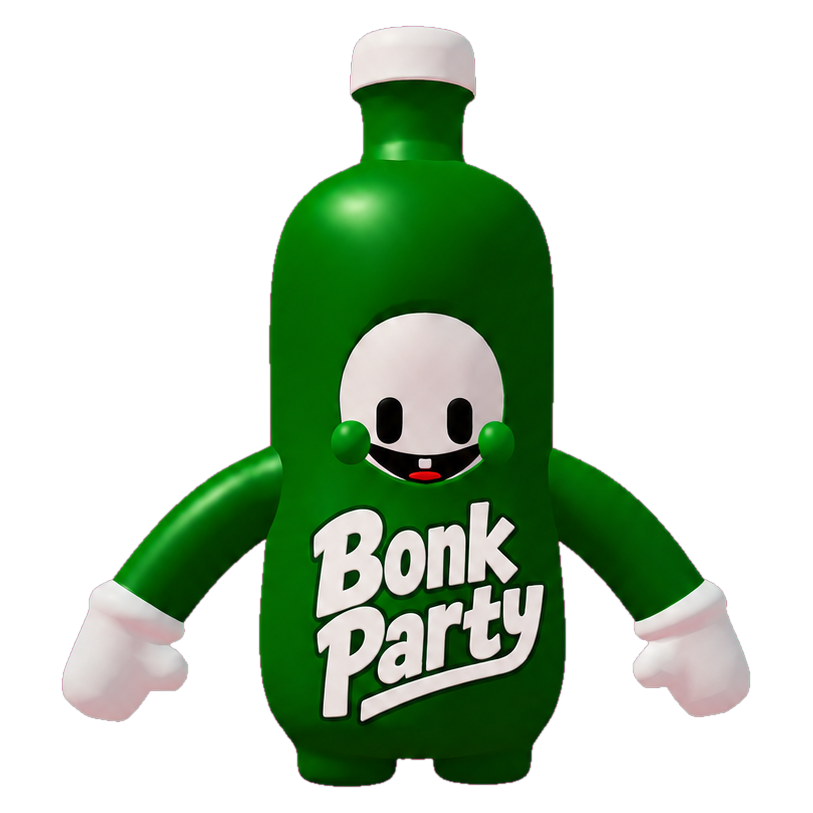
Bonker proportions exist for one reason: physical comedy. Every collision has to read clearly from across the arena. Personalities are cosmetic — nobody gets a stat advantage for picking the big one.
Six themed zones, each with its own hazard vocabulary. New seasons open new ones.
Every season brings new maps, obstacles, costumes, emotes and challenges. Because the obstacle system is modular, a handful of new pieces creates hundreds of new combinations without rebuilding the game.
Seven verbs, one cooldown and thirty-one people actively working against you. Here's the whole game.
Deliberately short. New players participate immediately; experienced players chain these into movement tech the map designers didn't plan for.
Hit the BONK and your Bonker throws a short shoulder-bump at whoever's nearby. It lands hard — and then it's gone for a moment. Press the button below to feel the rhythm.
Ready
Miss, and the cooldown leaves you standing still in the worst possible place. That's what turns player contact into tactics instead of noise.
A standard Party Royale runs five randomized rounds. Qualify or go watch.
Exaggerated character physics exist to manufacture funny moments — but you always keep authorship of your own mistakes.
Progression rewards showing up, not just winning. Qualifying pays. Finding a shortcut pays. Landing a BONK that changes a round pays.
You earn experience for participating in matches. A last-place finish with three good BONKs still moves you forward.
Customization is the point. Your Bonker is how the lobby recognizes you before you've done anything.
Each season introduces new maps, obstacles, costumes, emotes, challenges and a theme that reshapes Bonkland. Pass tiers unlock as you play — no tier requires winning.
Ranked play uses more skill-focused maps while keeping the game's chaotic personality. Fun first — but the ladder is there if you want it.
The reward design below is a proposal, not a live economy. Numbers, emission rates and eligibility rules need to be finalized before launch.
Every figure on this page and on Tokenomics is illustrative. Swap in your real emission schedule, wallet addresses and reward caps before this goes public.
One supply, one crown, no hidden mint. Hover the ring to break down the allocation.
TBA — paste your mint address here
Cosmetic-only, gameplay-neutral. Nothing purchasable gives a competitive advantage — that rule is load-bearing for the whole design.
$BONKP is a community token for a game in development. Every number on this page is placeholder copy for layout purposes and must be replaced with your audited, final figures before launch.
The full game design document — vision, systems, world, art and audio direction.